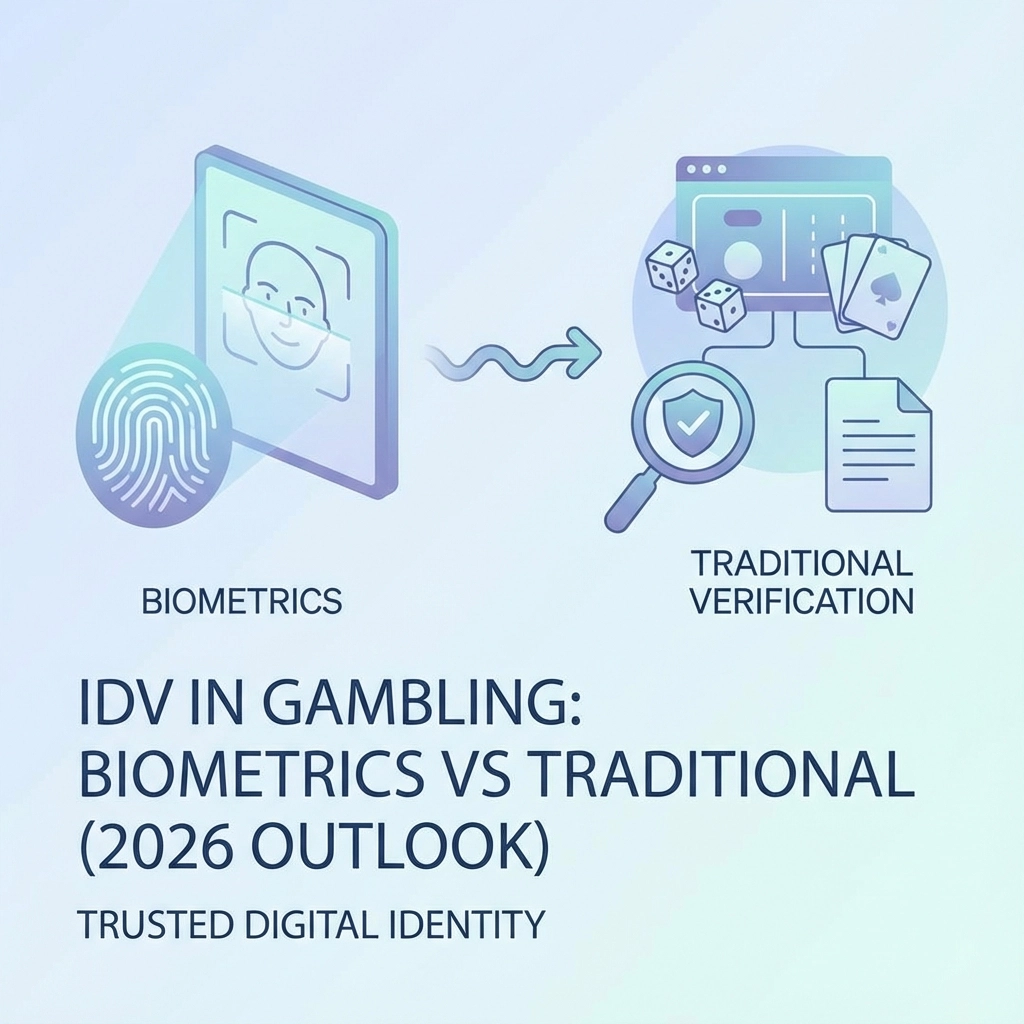
Identity verification (IDV) in gambling transforms how operators onboard players while maintaining regulatory compliance. Gaming platforms require robust verification systems that balance speed, security, and user experience: three elements that determine whether players complete registration or abandon the process entirely.
Traditional Verification: The Document-Heavy Approach
Traditional IDV relies on document submission and manual review processes. Players upload government-issued identification, proof of address documents, and payment method verification. This approach requires operators to maintain verification teams who manually review documents, cross-reference databases, and flag suspicious submissions.
The traditional process typically involves:
- Government ID Upload: Passport, driver's license, or national ID card submission
- Address Verification: Utility bills, bank statements, or council tax documents dated within 90 days
- Payment Method Confirmation: Credit card verification through small transactions or bank account validation
- Database Cross-Referencing: Electoral roll checks and third-party verification services

Traditional verification delivers reliable results but creates friction in the player journey. Document quality issues, manual review bottlenecks, and multi-step processes extend onboarding timelines from hours to days. Players often abandon registration during these extended verification periods, directly impacting operator conversion rates.
Biometric Verification: The AI-Powered Revolution
Biometric IDV leverages advanced technology to authenticate identity through biological characteristics. Modern biometric systems combine facial recognition, liveness detection, and document verification into seamless verification workflows that complete within minutes.
Key biometric technologies transforming gambling IDV include:
- Facial Recognition with Liveness Detection: Real-time selfie capture with movement verification prevents spoofing attacks
- Document Authentication: AI-powered analysis detects forged documents, altered text, and security feature validation
- Behavioral Biometrics: Keystroke patterns, mouse movements, and device interaction analysis create unique user profiles
- Voice Recognition: Audio verification adds an additional authentication layer for high-value transactions
Biometric systems process verification requests instantly, delivering real-time approval or rejection decisions. This technology eliminates manual review requirements while maintaining superior fraud detection capabilities compared to traditional document-only verification.
Speed Comparison: Minutes vs Hours
The time difference between traditional and biometric verification dramatically impacts operator performance metrics. Traditional verification typically requires 24-48 hours for manual review completion, while biometric systems deliver results within 30-120 seconds.

Traditional Verification Timeline:
- Document upload: 5-10 minutes
- Queue processing: 2-24 hours
- Manual review: 15-30 minutes
- Total time: 24-48 hours
Biometric Verification Timeline:
- Selfie capture: 30 seconds
- Document scan: 45 seconds
- AI processing: 15-30 seconds
- Total time: 90-180 seconds
This speed advantage translates directly into conversion rate improvements. Operators implementing biometric IDV report 40-60% higher completion rates compared to traditional document-only processes.
Fraud Detection Accuracy: AI vs Human Review
Biometric verification systems demonstrate superior fraud detection capabilities through machine learning algorithms trained on millions of verification attempts. AI systems identify patterns invisible to human reviewers, including micro-expressions in facial recognition and document manipulation techniques.
Traditional verification relies on human expertise to identify fraudulent documents, creating inconsistency in detection quality. Manual reviewers experience fatigue, varying skill levels, and subjective interpretation of suspicious indicators.
Biometric systems achieve 99.7% accuracy rates in legitimate user verification while maintaining false positive rates below 0.3%. Traditional manual review typically achieves 95-97% accuracy with 3-8% false positive rates, depending on reviewer training and experience levels.
Regulatory Compliance: Meeting 2026 Standards
Gaming regulations across multiple jurisdictions increasingly mandate enhanced verification standards that traditional methods struggle to satisfy efficiently. The UK Gambling Commission, Malta Gaming Authority, and emerging regulatory frameworks emphasize real-time verification capabilities and comprehensive audit trails.

Biometric verification systems generate detailed compliance reports including:
- Timestamp verification of all authentication steps
- Fraud score analysis and decision rationale
- Document authenticity verification results
- Liveness detection confirmation data
- Audit trail documentation for regulatory review
Traditional verification creates compliance challenges through manual process documentation, inconsistent decision criteria, and limited audit trail generation. Operators using traditional methods often require additional compliance overhead to meet regulatory documentation requirements.
Cost Analysis: Implementation vs Operation
Traditional verification requires significant ongoing operational costs through manual review teams, while biometric systems demand higher upfront technology investment with lower ongoing operational expenses.
Traditional Verification Costs:
- Verification team salaries: £35,000-45,000 annually per reviewer
- Training and quality assurance programs
- Document storage and management systems
- Compliance documentation overhead
Biometric Verification Costs:
- Technology licensing: £2-8 per verification
- Integration development: One-time cost
- Ongoing system maintenance
- Reduced operational overhead
Operators processing 10,000+ verifications monthly typically achieve cost savings within 6-12 months after implementing biometric IDV solutions.
ClearSignal's Advanced IDV Solution
ClearSignal's gaming and gambling verification platform combines biometric authentication with comprehensive AML screening and global data validation. The solution delivers complete verification workflows that satisfy regulatory requirements while optimizing player experience.
The platform integrates:
- Real-time biometric verification with liveness detection
- Global sanctions and PEP database screening
- Enhanced due diligence for high-risk players
- Automated compliance reporting and audit trails
- Multi-jurisdiction regulatory compliance support

ClearSignal's identity verification system processes verification requests within 60 seconds while maintaining industry-leading fraud detection accuracy. The solution eliminates manual review requirements for standard verifications while flagging complex cases for enhanced due diligence review.
Implementation Strategy for 2026
Successful biometric IDV implementation requires strategic planning that addresses technology integration, staff training, and regulatory compliance alignment. Operators should prioritize solutions that offer:
- API-First Integration: Seamless connection with existing registration systems
- Flexible Verification Workflows: Customizable processes for different player risk levels
- Comprehensive Compliance Reporting: Automated generation of regulatory documentation
- Scalable Architecture: Systems that handle traffic spikes during peak registration periods
The most effective approach combines immediate biometric verification for standard players with enhanced traditional verification for high-risk cases. This hybrid strategy optimizes conversion rates while maintaining rigorous compliance standards.
Future-Proofing Verification Systems
Gaming operators investing in IDV technology for 2026 must consider emerging verification trends including behavioral analytics, continuous authentication, and blockchain-based identity solutions. Biometric systems provide the technological foundation for these advanced verification capabilities.

Modern biometric platforms evolve continuously through machine learning improvements, expanding fraud detection capabilities and reducing verification friction over time. Traditional verification methods lack this adaptive capability, creating long-term competitive disadvantages for operators maintaining document-only processes.
The transition to biometric IDV represents more than technology adoption: it enables operators to compete effectively in markets where player expectations demand instant gratification combined with security assurance. Gaming platforms implementing advanced verification systems position themselves for sustainable growth in increasingly competitive markets.
ClearSignal's comprehensive compliance platform delivers the verification infrastructure gaming operators need to succeed in 2026's regulatory environment while maximizing player acquisition and retention rates.
